
You Won That Commercial Casework Contract. But Did You Make Any Money On It?
Millwork shops that quote on intuition and track costs at month-end are flying blind on every job. By the time you discover a project went over budget — because lumber ran 12% higher than estimated, or the custom spray finish took three times as long — the margin is gone and the client has moved on. Seradex Job Costing tracks every dollar of labour, material, machine time, and overhead in real time, so you know where you stand on every job, every day — and quote your next one with confidence.
Where Millwork Margin Goes Missing
The gap between your quoted margin and your actual margin lives in the details that manual job costing can't capture in time:
- The lumber order that came in 8% over the quoted price because your buyer had to use an alternate supplier
- The CNC routing that took 40% longer because the design had more internal corners than the estimator anticipated
- The spray booth time that doubled because a client changed to a two-tone finish after production started
- The hardware set that was pulled for another job and replaced with a pricier equivalent
Seradex captures all of it — automatically — so your project managers and owners have a real-time job cost view without chasing down paper time sheets and manual inventory logs.

What Seradex Job Costing Tracks — Automatically
Material Cost — Actual vs. Estimated
Every sheet of plywood, every board foot of hardwood, every metre of edgebanding consumed against a work order is posted to the job cost in real time. Compare actual material consumption to your BOM estimate — and see the variance before the job closes.
Labour — By Operation and Work Centre
Actual hours worked by every operator at every work centre are captured at the time of production. Seradex compares actual labour hours and wage rates to your estimated labour for each operation — and flags jobs that are running over budget on time.
Hardware & Purchased Components
Hardware sets, inserts, drawer slides, and specialty components are tracked to the job at the time of consumption. No more month-end reconciliation to figure out where your hardware budget went.
Machine Time & Overhead Absorption
Define overhead rates by work centre — CNC router, edge bander, spray booth — and Seradex automatically absorbs overhead into your job cost based on actual machine hours. Your job cost reflects the true all-in cost of production, not just direct materials and labour.
Change Order Cost Tracking
When a client requests a change — a door profile revision, a species upgrade, additional shelving — Seradex calculates the incremental cost automatically and adds it to the change order record. Every dollar of scope change is documented and recoverable.
Real-Time Margin by Job, Customer, and Product Line
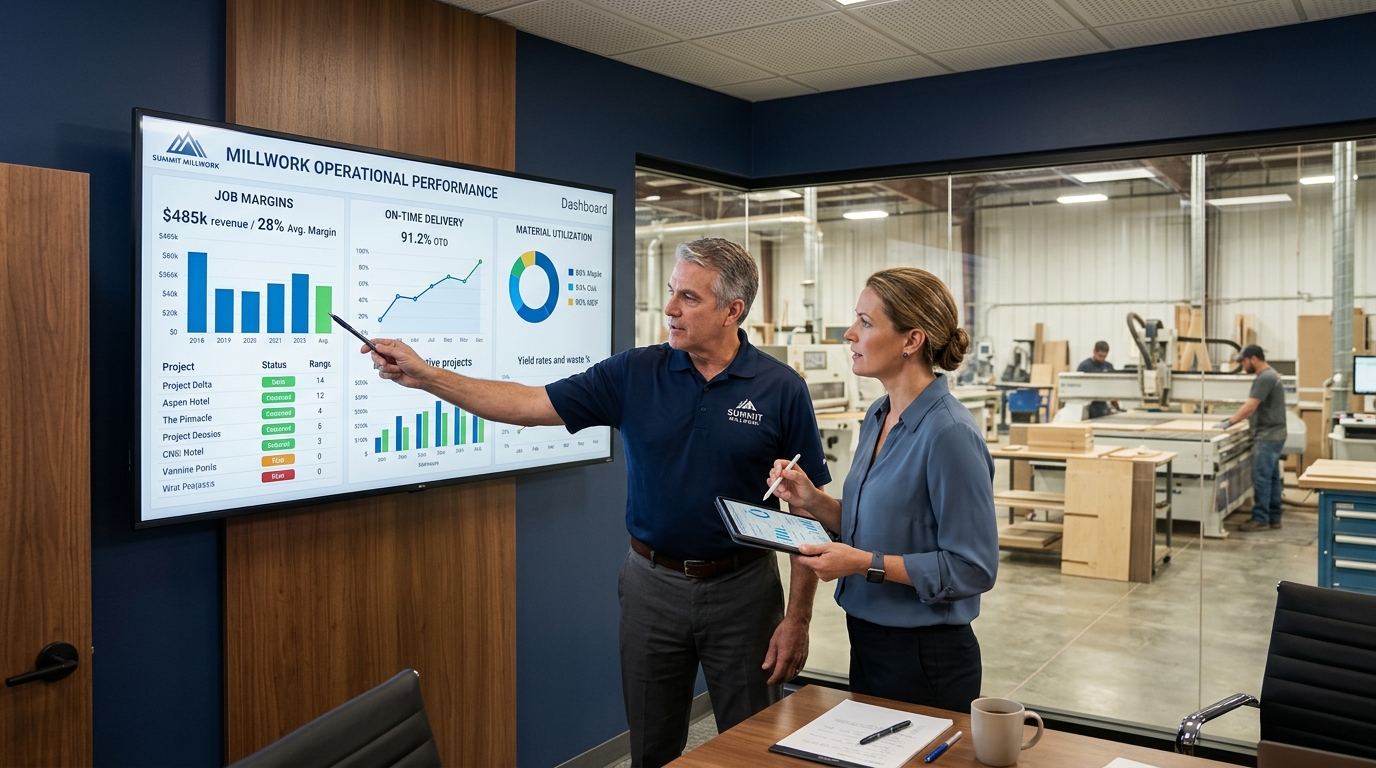
Your job cost dashboard shows current margin on every open project — updated continuously. You see immediately when a project is trending below your target margin and can act before it's too late.
From Quote to Close: The Seradex Job Costing Lifecycle
Use case 1:
Quoting
Your estimator builds the quote using Seradex's BOM-driven quoting engine — pulling current material costs, your standard labour rates by work centre, and your overhead absorption rates. The quote becomes the budget. The budget becomes the benchmark.
Use case 2:
Production
As work orders progress, every material consumed, every hour worked, and every machine minute used is posted to the job cost automatically. Your project manager can pull a live job cost summary at any moment — without talking to accounting.
Use case 3:
Change Orders
Client requests a change? Seradex calculates the cost impact instantly — additional materials, labour, and machine time. The change order is issued with full cost backup. Approved changes are added to the job budget so your margin target is maintained.
Use case 4:
Job Close & Analysis
When the project is complete, Seradex generates a full estimated vs. actual cost analysis — by material category, by work centre, by operation. These actuals feed directly into your quoting history, making your next similar project estimate more accurate.
Use case 5:
Portfolio Reporting
Across all active and closed jobs, Seradex shows you margin by customer, by product type, by salesperson, and by time period. You know which parts of your business are profitable and which are subsidizing others.
The Financial Impact of Real-Time Job Costing
Accurate, real-time job costing supports project profit margin improvements of up to 15%, can reduce cost overruns versus estimates by up to 20%, and drives a significant lift in quoting accuracy for similar jobs because actuals feed back into estimates.
Frequently Asked Questions
Answers to common questions to help you better understand our solutions and processes.
How quickly does job cost data update after production activity?
Real-time. As soon as an operator logs a material consumption or completes an operation at the shop floor workstation, the job cost is updated. There is no batch processing or end-of-day reconciliation.
Can we set job-level margin alerts?
Yes. Define a minimum acceptable margin percentage for each job or job type. Seradex alerts your project manager and owner when a job's current trajectory puts it below that threshold.
How does Seradex handle jobs where material costs fluctuate mid-project?
Seradex records the actual cost of materials at the time of receipt — so if your lumber price rises between quote and delivery, the job cost reflects the actual purchase price. Variance from the estimated cost is reported separately.
Can we see profitability by customer or by product category?
Yes. Seradex's reporting allows you to analyze margin by any combination of customer, product type, salesperson, work centre, and time period — giving you a complete picture of where your profit is coming from.
Does job costing integrate with our accounting system?
Seradex integrates with common accounting platforms. Contact us to confirm compatibility with your current accounting software.
"I used to wait until month-end to find out if we made money. Half the time it was too late to do anything about it. With Seradex, I can pull up any job on any day and see where the margin is. We've stopped taking certain types of projects because we finally had the data to prove they were never as profitable as we thought."
— Owner, Custom Residential & Commercial Millwork
ARE YOU READY?
Stop Discovering Lost Margin at Month-End. Start Managing It Daily.
Book a demo and see how Seradex puts real-time job costing in the hands of your project managers, estimators, and business owners — so every decision is backed by accurate, current financial data.