
Three Jobs Due Friday. One CNC Down on Wednesday. Who Moves First?
Scheduling in a millwork shop isn't just about dates on a calendar. It's about managing dozens of interdependent operations - panel saw, CNC routing, edge banding, assembly, finishing - across multiple concurrent projects, while accommodating rush orders, machine downtime, and last-minute change orders. Seradex ERP gives you a real-time command centre for every job in your shop, so the right work is at the right work centre at the right time - every day.
The Scheduling Challenge That's Unique to Millwork
Unlike repetitive manufacturing, millwork is characterized by high product variability and interdependent operations. A run of 80 painted MDF cabinet boxes follows a different sequence than a set of site-finished walnut display cases - yet both may be running simultaneously in your shop, competing for the same equipment and the same skilled operators.
When scheduling happens in someone's head, on a whiteboard, or in a spreadsheet that only one person understands, the risk is enormous. Seradex makes your production schedule a shared, live, system-managed asset - visible to your production planners, your shop foreman, your project managers, and your sales team, all in real time.
What Seradex Scheduling Delivers for Millwork Operations
Gantt-Style Visual Production Scheduling
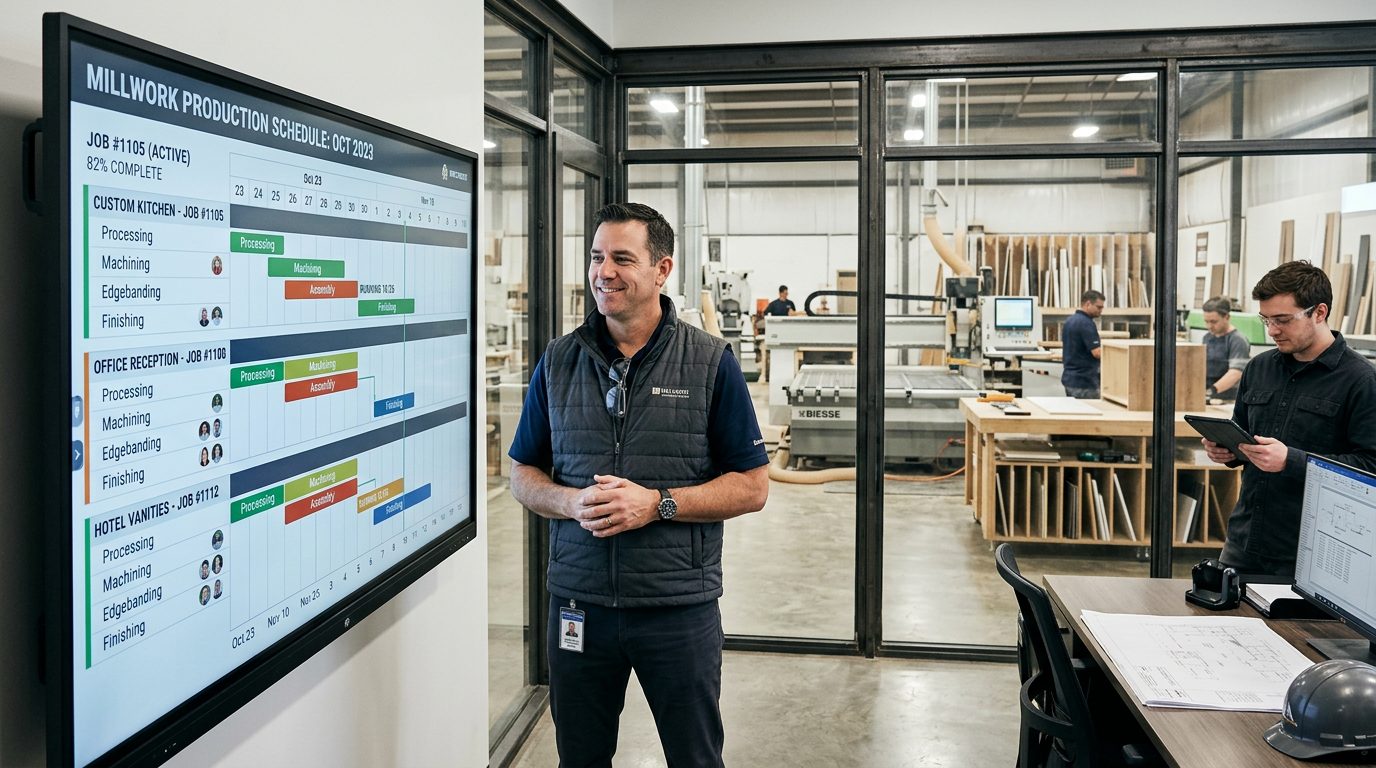
See every open job plotted across a time horizon, broken down by phase and work centre. Drag and reschedule operations visually. Seradex updates all downstream dependencies automatically when you move a job.
Work Centre Queue Management
Each work centre - panel saw, CNC router, edge bander, veneer press, assembly bench, spray booth - has a live queue. You see what's currently running, what's next, and what's waiting for materials or a preceding operation. Bottlenecks are visible before they become delays.
Dynamic Rescheduling on Exceptions
When a CNC router goes down or a critical material delivery is delayed, Seradex shows you the downstream impact on every affected work order and helps you reprioritize. You make the call; the system updates every queue automatically.
Dependency-Aware Sequencing
Seradex understands that sanding can't happen before routing, and finishing can't happen before assembly. Operations are sequenced with dependencies enforced - so jobs can't advance to a work centre before their preceding operations are complete.
Material Availability Gate
Work orders are only scheduled for production when the required materials - sheet goods, lumber, hardware, and finish - are confirmed available or have a confirmed delivery date. No more starting jobs that stall mid-production.
Delivery Risk Alerts
Seradex continuously monitors your in-progress jobs against committed delivery dates. When a job falls behind the threshold that would impact on-time delivery, your planner and project manager are alerted - with enough lead time to act, not react.
Scheduling Scenarios Seradex Handles Daily
Scenario 1:
The Multi-Phase Commercial Project
A 400-unit condo development requires cabinetry delivered in 8 phased drops over 14 weeks. Seradex manages each drop as a sub-project within the master schedule - maintaining a consolidated view of the full contract while keeping each phase on its own production timeline with its own material plan and delivery target.
Scenario 2:
The Rush Job Insertion
A long-term GC client needs a 12-unit kitchen package in 10 days - ahead of two existing jobs. Seradex models the reschedule in seconds, showing you the impact on your committed delivery dates. You make an informed decision, not a gut call.
Scenario 3:
The Machine Breakdown Recovery
Your CNC router goes down Monday morning. Seradex shows you which work orders are now at risk, flags which ones can be rerouted to your secondary router or outsourced, and auto-updates your delivery risk view. Your team has a recovery plan in minutes.
Scenario 4:
The Custom Residential Project
A high-end custom home requires 11 rooms of site-finished white oak millwork, phased around the general contractor's framing and drywall schedule. Seradex ties your production schedule to the site schedule - alerting your planner when the GC's progress signals it's time to start the next phase.
Scheduling That Delivers Results
Seradex scheduling is associated with up to 30% better on-time delivery on commercial projects, up to 25% fewer labour and equipment conflicts, and a significant reduction in emergency overtime driven by last-minute schedule surprises.
Frequently Asked Questions
Answers to common questions to help you better understand our solutions and processes.
How many concurrent projects can Seradex schedule?
Seradex is designed for multi-project environments with no hard limit on concurrent work orders. The scheduling system is optimized for the variability typical of millwork shops running 20–200+ concurrent jobs.
Can project schedules be shared with clients or general contractors?
Yes. Seradex's customer and contractor portal allows you to expose project milestones and delivery dates to external stakeholders - without giving them access to your internal scheduling data.
Does the scheduling system account for statutory holidays and shift patterns?
Yes. Seradex's production calendar is fully configurable - define your shifts, statutory holidays, scheduled maintenance windows, and overtime availability per work centre.
What happens to the schedule when a rush job is inserted?
Seradex shows you the downstream impact on your committed jobs immediately. You can model different insertion scenarios and accept the one that minimizes disruption before making any changes to the live schedule.
Can we integrate our site schedules from external project management tools?
Seradex supports data imports and API integration. Contact our implementation team to discuss connecting your Procore, Microsoft Project, or other project management data.
"We were managing six commercial projects simultaneously with a whiteboard and a lot of stress. Seradex gave us visibility we didn't know we were missing. Our on-time delivery went from about 70% to over 95% in a year - and our owner stopped getting late-night calls from GCs."
— Production Planner, Commercial Casework & Millwork Manufacturer

ARE YOU READY?
Every Job, Every Work Centre, Every Deadline - Under Control.
See how Seradex gives millwork manufacturers a live, dynamic production schedule that adapts to your reality. Book a demo personalized to your shop's complexity.